
Detailed guidance on applying for a Large Grant.
We are committed to making our website accessible to everyone. Accessibility and translation tools are available via the blue Recite Me button at the bottom right of this page. You can access reading aids, screen reader functionality and translation into 134 languages.
British Sign Language (BSL) users can contact us through an interpreter via Contact Scotland BSL, a free national BSL interpreting video relay service.
If you have any communication support needs that make reading this guidance difficult or impossible, please get in touch with us by emailing funding@therobertsontrust.org.uk or calling 0141 353 4321 to discuss alternative ways to find out about this fund.
We occasionally update our guidance documents in response to external feedback/developments. The guidance was last updated in September 2026 - please ensure you are working from the latest iteration if you are planning to apply for funding.
You can apply if your organisation:
Is a registered charity, either with OSCR or the Charity Commission
Works in Scotland
Has an annual income of between £200,000 and £2million*
Has a minimum of three unconnected Trustees on its Board. By unconnected we mean not related to each other; married or in a civil partnership with each other; in a relationship with each other or living together at the same address.
Supports people who are experiencing (or who are at higher risk of experiencing) poverty and associated complex trauma, by delivering work that is clearly and intentionally aligned to a priority described within one or more of our funding themes
*If you are a returning applicant under our current strategy and your income is between £2M and £3M, we may be able to consider an application from you. Please contact your Funding Officer in the first instance to discuss your eligibility to apply.
Charities who are already in receipt of a Small Grant, Community Spaces Grant or Large Grant from us. If you wish to apply for further funding, the earliest you can do so is 8 months before the end of your current grant period. If successful, we would not release any funds before your existing grant ends and you’ve sent us your End of Grant Report.
The following types of organisations are not currently eligible for funding through our open, responsive grant streams, including Large Grants. However, we are committed to reviewing our guidance and criteria across the course of our strategy. To be kept informed, please sign up to our mailing list.
Housing Associations and Arm’s Length External Organisations (ALEOs - these are organisations which are formally separate from the local authority but still subject to its control or influence).
Community Interest Companies (CICs). At present, CICs are not eligible to apply to our open funds, including Large Grants. Due to the immense pressure the organisations we already fund are experiencing, we want to ensure we can continue meeting their needs effectively before expanding our applicant pool. Asset-locked CICs are however able to apply to our Big Change that Lasts and Advancing Racial Justice funds and, as our Social Impact Investing work opens, we envisage being able to offer affordable loans to some asset-locked CICs whose work is strongly aligned to our mission, via investment partners. You can sign up to our mailing list to keep informed of future opportunities for funding.
Large Grants can provide unrestricted or restricted revenue funding of between £20,000 and £50,000 per year, typically for three years.
We particularly welcome applications for unrestricted funding where your organisation’s work is purposely designed to address a priority described within one or more of our themes, described below.
Subject to available funds, we may consider up to five years’ funding for requests which are strongly aligned with our priorities, have a clear focus on prevention or longer-term change in their work, and demonstrate leading or best practice. We will normally only consider 5-year funding for organisations with whom we have an existing funding relationship.
Through our Large Grants, as with all our funding, we want to support work that seeks to prevent or reduce poverty and associated complex trauma for people and places in Scotland.
Poverty means not having enough money to be able to buy the things your household needs and to participate fully in society.
Complex trauma is a form of trauma that is usually experienced interpersonally, persists over time and is difficult to escape from. It is a series of multiple experiences of trauma that can overlap and intersect and is often experienced in the context of close relationships and chronically unsafe environments (e.g. childhood abuse or domestic abuse). (National Trauma Transformation Programme).
We know that often where people experience poverty, they may also experience related types of trauma. We are concerned specifically with the trauma that impacts within families and where a significant contributing factor is the experience of poverty, especially deep and enduring poverty.
Not everyone in poverty will experience complex trauma. We recognise, however, that poverty can both increase the risks of experiencing complex trauma and weaken the protective factors that can help people avoid the potential long-term impact of complex trauma. Without support, the experience of complex trauma can have long-term effects, which can impact on people’s mental health, relationships and experiences accessing services. This can keep people locked into poverty and potentially lead to effects of trauma being passed down between generations.
As we know that not everyone who experiences poverty will also experience complex trauma, we will fund work which is either:
focused solely on preventing or reducing poverty, or;
which seeks to prevent or reduce poverty and complex trauma together, where the experiences are interlinked.
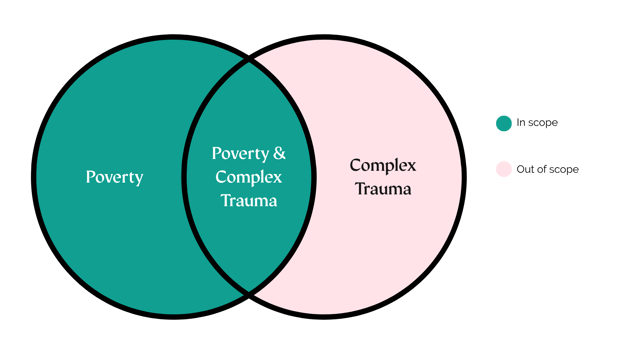
We want our funding to help prevent and reduce poverty and associated complex trauma, tackling the material aspects of poverty now and the effect on longer-term prospects that are often related. We are especially interested in work that supports building resilience and recovery.
Please note: We do not fund work focused on types of trauma often referred to as Type 1 Trauma, which stems from a single, sudden, unexpected event that threatens a person's safety. Examples include accidents, natural disasters, or sudden physical assaults. Whilst we understand the severity of these types of trauma and their impacts on individuals, they are not connected in the same way as complex trauma to the experience of poverty.
Our Themes and Priorities
We are interested in funding work which is clearly and intentionally designed to address one of the priorities described within our funding themes (please click the links for more details):
Financial Security – Through this theme, we want to see a Scotland where people are financially secure and able to live free from poverty and associated complex trauma. We want to fund work that focuses on improving income adequacy, income security, manageable costs, financial safety nets and advice for those most at risk of poverty and associated complex trauma. Our priorities are:
helping people who are struggling with day-to-day costs
creating access to advice, support and advocacy around social security, debt reduction, income maximisation, housing
Some examples of work we could support include services which provide access to affordable items, such as food and clothing, or access to advice and information around welfare benefits, income maximisation and better financial security
Education Pathways – Through this theme, we want to see an education system in Scotland which acts as a pathway out of poverty. We want to support solutions which enable those experiencing poverty and associated complex trauma to access and engage in early years, education, training and learning, developing skills, capabilities, resilience and achievements that will help them thrive. Our priorities are:
supporting educational engagement amongst children and young people experiencing or at risk of experiencing poverty
supporting educational attainment amongst children and young people experiencing or at risk of experiencing poverty
supporting the engagement of parents and wider family members (of children and young people experiencing or at risk of experiencing poverty) in their child’s education and learning
Some examples of work we could consider funding include services focused on widening access to education, engaging families in learning, mentoring schemes, tutoring, supporting transitions, alternative education for young people experiencing barriers, youth work, apprenticeships and practical placement learning.
Work Pathways – Through this theme, we want to see a Scotland where paid work is a more reliable route out of poverty. Our priorities are:
supporting people experiencing or at risk of experiencing poverty with the transition through education and training into good or fair work
supporting people experiencing or at risk of experiencing poverty with the skills they require to secure good and fair work
addressing the financial and other significant barriers to employment, training and work.
Some examples of work we could consider funding include training, employability and career development support. We are particularly interested in services which are focused on areas or groups with lower employment rates and which engage with employers to help remove barriers to work.
Nurturing Relationships – Through this theme, we want to support strong, trusting and healthy relationships within families and communities to help break cycles of persistent poverty and intergenerational trauma, and enable people to recover and thrive. Our priorities are:
Preventative support for families in poverty (including children and their caregivers), to help build and maintain strong family relationships, and reduce the risk of intergenerational trauma.
Whole family support for families (including children and their caregivers) in care, or on the edges of care, to address the impacts of persistent poverty and intergenerational trauma. We will also fund services for young people who have experience of care who are not in a family setting.
Crisis support at the point of family breakdown, including support for women and children experiencing domestic abuse. We particularly want to support:
Services supporting families on low incomes, particularly in areas of deprivation, or remote and rural communities.
Services which also provide support to build financial security.
Services which provide whole family support.
Recovery and restorative approaches to address the impacts of childhood trauma, homelessness, substance misuse and/or contact with the criminal justice system. We are particularly interested in work which takes a holistic approach, also addressing individuals’ financial and wider needs. This could be directly delivered by the applicant organisation or through relationships with specialist partners.
Some examples of work we could consider funding include family support services for families experiencing poverty, holistic support for young people with care experience, women’s aid services and homelessness support services.
The examples listed are not exhaustive. For live examples, you can find our latest awards listed by theme and priority in the News section of our website.
We are particularly interested in work which includes a focus on prevention. We ask about this in our application form and categorise work as:
Prevention – addressing the root causes of poverty to stop problems arising.
Early help - identifying challenges early and intervening before they become more serious.
Immediate need – responding to existing challenges and reducing their impact.
We expect that organisations applying for a Large Grant will mostly be focused on early help and immediate need but we are interested to see applications where work involves tackling root causes, for example influencing change in systems such as housing and education.
We can fund work which:
tests new approaches or does more of what works.
is universal (aimed at a wide group of people or an entire community) or targeted (focusing on a specific group, e.g. young people), as long as it shows how it will reach and meet the needs of people (at higher risk of) experiencing poverty and associated complex trauma.
Groups of people affected by poverty and associated complex trauma: We would like to fund work focusing on groups of people who experience higher rates of poverty and associated complex trauma, or who are at higher risk, than the population as a whole. We are focused on those groups in Scotland who are more likely to experience low incomes and restricted opportunities as a result. These groups include but are not limited to:
Lone parent families
Child poverty priority family groups (including larger families, families with young children, and young parent families)
People experiencing severe or multiple disadvantage (e.g. due to homelessness, substance misuse and offending)
Disabled people
Communities experiencing racial inequity
Asylum seekers, refugees and those with no recourse to public funds
Households claiming Universal Credit or related low-income social security benefits
People with experience of the care system
Unpaid Carers
Women with low incomes
Young people (in most cases up to age 25, or 30 for those with additional support needs)
Older people with low incomes
Geographic communities that are rural or remote, or in areas of high deprivation.
We will also consider work which is not specifically aimed at these groups but which provides earlier help to prevent or reduce the likelihood of experiencing negative outcomes relating to poverty and associated complex trauma.
Where targeting people on low incomes is difficult, such as in rural or remote areas, we recognise that services need to be more general rather than specialist in nature as a result. For example, a service working with families in a rural community, including but not limited to those experiencing poverty. In such cases we would ask that you share evidence of the impact, or planned impact, of your work on preventing and reducing poverty and associated complex trauma for the people and place you serve, in line with our funding priorities described above.
.
We’re happy to fund most costs, but there are certain costs and activities we would not consider supporting:
Work which takes place outside Scotland.
Work focused on types of trauma often referred to as Type 1 Trauma, which stems from a single, sudden, unexpected event that threatens a person's safety. Examples include accidents, natural disasters, or sudden physical assaults. Whilst we understand the severity of these types of trauma and their impacts on individuals, they are not connected in the same way as complex trauma to the experience of poverty.
Funding for individuals (by this we mean we won’t provide funding which will primarily benefit only one or a very small group of individuals, although we could consider funding to provide e.g. vouchers to individuals to help with the costs of essentials).
1-2-1 counselling or general mental health support where this is not provided as part of a holistic, whole family approach designed to strengthen relationships between children, young people and their caregivers, or as part of a holistic programme of recovery for individuals with experience of childhood trauma, homelessness, substance misuse and/or offending.
Whilst we can provide funding to faith-based organisations delivering services and activities for the wider community, we cannot contribute towards projects and activities which incorporate the promotion of religious beliefs, or requests for salaried posts and volunteer costs where there is a requirement to be of a particular faith or none. This is because of the Trust’s commitment to support and enable equal access to activities, employment and volunteering opportunities, regardless of whether an individual is of a particular faith or none. The same applies to the promotion of political beliefs/activities.
Feasibility studies or academic research.
Replacement of statutory revenue funding for mainstream playgroups and nurseries.
Standalone costs of childcare provision, although we may consider making a contribution towards childcare costs as part of a broader programme of support to help individuals access education or work, where childcare presents a barrier to this, or as part of a broader programme of family support.
Funding to support work which is considered a statutory responsibility such as teacher training or curricular activity in schools.
Day care or residential care for older people.
Standalone events or festivals – i.e. events that are not part of a larger programme of work relating to poverty and associated complex trauma.
Any retrospective costs already incurred by the applicant organisation.
Any costs not incurred by (or the salaries of staff not directly employed by) the applicant organisation.
The salary costs of staff who are also Trustees/Directors on the applicant organisation’s Board.
Capital costs such as building or renovation works, although, as above, we may consider small items of equipment as part of your revenue request.
If any of the above costs make up a large part of your organisation’s annual expenditure, we will be more likely to restrict any grant we award you.
Our application process has two stages: an initial enquiry followed by a full application and assessment.
We accept initial enquiries on a rolling basis, with no closing dates.
Stage One – Initial Enquiry
If you would like to be considered for a Large Grant, please send us a short outline of your work using our Enquiries Form. You can see a sample enquiries form here.
Our team will review this to determine whether your work is aligned with our priorities and is something we could consider funding. We’ll respond to your enquiry within 4 weeks.
If we think your work is something we could potentially support, we’ll email you a link to our full application form, in which we’ll ask you to provide more details about your request. We’ll agree a deadline by which you need to send us your application, and we’ll give an indication of when you will receive a decision. This will typically be within 12 weeks of your deadline. If we don’t receive your application by the agreed deadline, this will result in a delay to our decision-making.
If your work isn’t something we could support, we’ll email you to advise and let you know the reason why.
There may be occasions where, due high demand and budget limitations, we receive more fundable enquiries than we can invite to apply. In such cases, we’ll prioritise those requests which have the strongest alignment with our funding priorities and therefore the best chance of receiving funding. If we can’t invite you to apply due to demand, we’ll let you know if there are ways you could strengthen a future request to us.
Stage Two – Full Application
If we invite you to make a full application, you will need:
Recent independently examined or audited annual accounts. If your organisation is a newly registered charity which has not yet produced accounts, we’ll ask you to send us details of an independent referee, a recent bank statement and a financial projection showing your organisation’s expected income for its first year. We may also ask you to send us a copy of your most recent management accounts so that we can better understand your current financial position.
A bank account in the name of your charity, with two unconnected people required to make every withdrawal or payment.
A policy on Equality, Diversity and Inclusion. We want to know that your organisation has a written agreement detailing how you will avoid discriminating against people, and how you will create a safe and inclusive atmosphere both within your workplace and for the people you support.
A safeguarding policy. If your organisation directly supports children and young people or vulnerable adults, we would expect you to have an appropriate policy document which sets out how you will keep them safe. Further information and resources can be found on the OSCR website here.
A full job description if your request is for funding towards a specific salary cost.
In the application form, we will ask you to tell us more about your organisation, its work and your request for funding. We’ll also ask you to provide a fully costed budget, using our template.
We consider a number of key criteria when assessing full applications. As well as meeting the basic requirements and fit with our themes and associated priorities, as outlined above in the ‘What type of work will you fund’ section, we want all organisations who apply for a Large Grant to demonstrate how their work aims to prevent or reduce poverty and associated complex trauma. This is the most important consideration to us as a funder and will influence the level of funding that we are able to offer.
Focus on preventing or reducing poverty and associated complex trauma: In your application, we’ll look for you to show us that you recognise the challenges people in your community are facing in their lives related to poverty and associated complex trauma, as well as how your work will respond to this and support them, and/or work to prevent future experiences of poverty and associated complex trauma.
If you are applying for a higher level of funding, for example over £40,000 a year, you should show how your work is specifically targeted at people who are facing poverty and associated complex trauma. Your organisation should have a commitment and track record in applying good practice approaches and may be recognised as a leader in its field. You should clearly demonstrate how your work will make a difference through a preventative approach, and may potentially bring about change at practice, organisational or system level. Your work may test new approaches, or may build on what already works.
We also ask you to demonstrate how you:
Focus on community participation: by showing that you involve your community in the organisation, for example on the Board or through volunteering; and that you listen to your community and respond to their needs. By community, we mean either a geographic community or a community of interest (a group of people with shared characteristics and/or experiences). We are also interested to know how you include people from diverse communities (for example disabled people or people experiencing racial inequity) and remove barriers to their participation.
If you are applying for a higher level of funding, you should demonstrate how you have listened to people with lived experience of the issues you act on, and show how you have considered their views in the design and delivery of your services.
Focus on relationships and rights: by showing that your work has a clear relational focus (i.e. that your organisation treats people as individuals with equity, dignity and respect) and that this is reflected in your policies and governance.
If you are applying for a higher level of funding, you should be able to demonstrate an assets-based approach to support an individual’s independence, resilience, and an ability to make their own choices. Your organisation should have detailed plans in place to ensure that the board, staff and volunteers are poverty and trauma aware, are effectively supervised and supported, and have relevant skills, knowledge and training appropriate to the target group of people accessing your services.
Focus on collaboration: by showing that you are aware of other groups and services in your area, including those delivering related work, and are linked in with them, for example, through referrals, partnership working or participating in local networks.
If you are applying for a higher level of funding, you should be able to demonstrate a willingness and track record of working collaboratively and have clear plans to share learning from your organisation’s work. You should be able to demonstrate a clear understanding of key local, regional and national strategies and provide examples of practice and influencing which reflect this.
If you plan to deliver your work in a formal partnership or consortium with other charities and would like to discuss how we might support this, please contact us at funding@therobertsontrust.org.uk.
Other criteria we consider include:
The size of grant your organisation is asking for, relative to its annual income – we try to be proportionate in how much we award.
Your organisation’s financial position, including its sustainability and whether it has an immediate need for our funds.
How your organisation is governed.
The duration and the scale of your organisation’s work, for example delivered at local, regional or national levels, and the number of people it will support.
If you are a returning applicant, currently or previously funded under our 2010-2020 strategy, and applying for further funding to continue your work, we’ll want to understand the difference our funding helped to make. If you’ve not already sent us your End of Grant Report, please tell us in your application about examples of impact, any new developments in your work, and any learning gained during the previous funding period that’s helped inform your services and approach going forward.
We recognise that many organisations now use AI tools as part of their day-to-day work, and we understand the potential value they can bring when preparing an application. You can use AI to support your application, but please make sure you read our guidance before you do so.
Our guidance explains what we expect from applicants, how information should be presented, and the standards your application must meet. It’s important that your final application reflects your organisation’s own ideas, plans, and evidence — not content generated solely by AI.
If you choose to use AI tools, please ensure that:
The information is accurate, appropriate, and genuinely represents your project.
You review, edit, and take full ownership of the final application.
You follow all requirements set out in our guidance.
We have designed our two-stage application process to help reduce the number of generic AI-generated applications we receive. We prioritise requests where the applicant’s voice is clearly evident.
Upon receipt of your full application, we’ll send you an acknowledgement email confirming this.
We’ll send all correspondence about your application via email, so it’s important that the email addresses and contact details you provide in your application are correct. We’ll normally contact the person you’ve listed as the ‘application contact’ in the first instance, so it’s helpful if this person is available during the assessment period. Please let us know if there are any changes to the contact details provided.
We’ll assign one of our Funding Officers to assess your application. They may get in touch with you during the assessment period and will be able to help you with any changes or updates you might need to make to your application, or any additional information you need to provide. Any delays to receiving additional information could result in a delay to our decision-making.
We’ll consider your application at our next available decision meeting. If the date of this meeting is different to the one we shared with you at initial enquiry stage, we will let you know. We are normally able to let you know the outcome of your application within a week of the meeting taking place.
If we award you funding:
We’ll email you to let you know. Before we can pay your funds, we’ll ask you to provide a copy of a recent bank statement for your organisation’s account (within the last three months).
We may also ask you to complete certain actions before we can pay your funds. This is more likely to be the case for restricted awards rather than unrestricted. For example, we might ask you to provide evidence of other funding or let us know when a new postholder has been appointed.
Once we have the information we’ve asked for, we’ll do our best to pay the funds to your organisation’s bank account within two weeks.
We’ll ask that you send us a brief report at the end of each grant year telling us about your progress, the differences or outcomes your work has contributed to making for the people and communities you support, and what has helped to make those differences. We may use information from your report to highlight stories and case studies used as part of our Communications work. We may also request to visit you, or speak to you on the phone or online, to find out how you’re getting on and whether you need any additional support from us.
As you approach the end of your grant, we know you may be thinking about further funding. You can reapply to us from 8 months before the end of your grant period. If successful, we would not release any funds before your existing grant ends and you’ve sent us your End of Grant Report.
Take a look at the Support for grant holders section.
If we do not award you funding:
We’ll send you an email in which we’ll try our best to explain why we’ve not awarded you funding. We will also let you know in our email how soon you can re-apply. If the reason we haven’t awarded you funding is something we both think you can address, you may be able to re-apply once you have been able to do so. We’ll explain this in the email. If the reason you have been unsuccessful is something we don’t feel can be easily addressed, we will ask you to wait 12 months before considering reapplying.
If you would like to have a chat with us about our decision and whether – or how soon – you can re-apply, you can email us at funding@therobertsontrust.org.uk and your Funding Officer will aim to get back to you within five working days.
Annual Income: This is normally based on the money your organisation received in the last financial year, as shown in your most recent annual accounts. We understand, however, that organisations’ income may fluctuate from year to year and we’ll therefore look at up to your last three years’ income, as presented on OSCR. If you are a new organisation, which has not yet produced accounts, we’ll look at the income you expect to receive in the year ahead. As a general rule, we will only accept applications for Large Grants from charities whose annual income is over £200,000 and up to £2 million. There are some cases where we will make exceptions, for example, if your income last year was less than £200,000 but you are growing your activities and projecting increased costs; or if your income was over £2 million due to one-off funding for a capital project. If you would like to be considered for a Large Grant but you’re still not sure if it’s right for your charity, please call us on 0141 353 4321 to discuss.
If you are a returning applicant under our current strategy and your income is between £2M and £3M, we may be able to consider an application from you. Please contact your Funding Officer in the first instance to discuss your eligibility to apply.
Revenue funding: is used to cover the costs of providing day-to-day services. We can provide revenue funding in two ways:
Unrestricted funding: can be spent on the annual running costs of your organisation, such as salaries, heating, lighting, administration, consumables and small items of equipment, such as laptops. We particularly welcome applications for unrestricted funding where your organisation’s work is purposely designed to address a priority described within one or more of our themes.
Restricted funding: can only be used for a specific project, activity or designated purpose, as applied or identified and agreed by us as being aligned to a priority described within one or more of our themes.
We’ve done our best to make sure the above guidance is clear, however, if you have any feedback on this, we’d welcome the chance to talk to you about it.
If you have any questions about applying for a Large Grant, please contact us on the details below:
0141 353 4321